
An EOV makes a critical contribution to characterizing the state of the world’s oceans and climate system.
14 Sep, 2026
Christoph Waldmann, IEEE Life Senior Member, BEACON Contributing Editor
The World Meteorological Organization (WMO, www.wmo.int) Guide to Instruments and Methods of Observation was first published in 1954 and has since evolved into a multi-volume reference covering measurement methods for a wide range of operational meteorological, climatological, and oceanographic variables, including many of the Essential Climate Variables (ECVs).
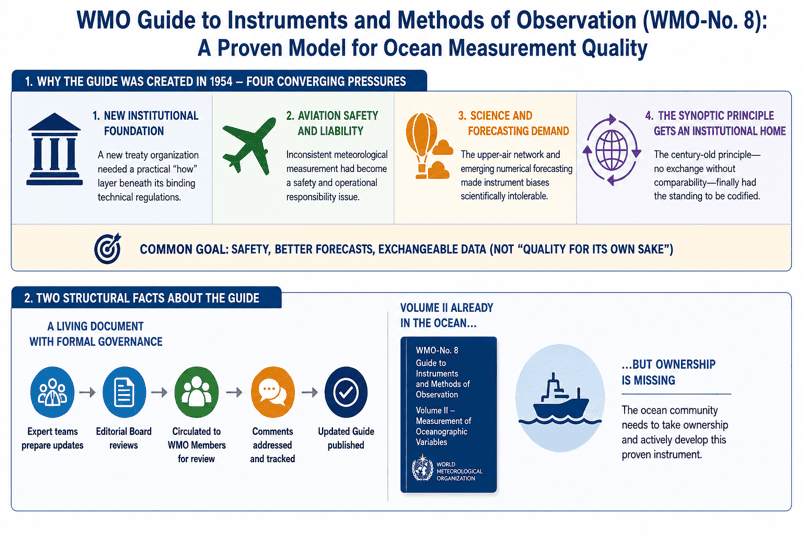
The establishment of the Guide in 1954 can be understood as the result of four converging pressures. First, the newly created treaty-based organization required a practical “how-to” layer beneath its binding Technical Regulations. Second, the rapid expansion of aviation had turned inconsistencies in meteorological measurements into issues of safety and operational responsibility. Third, the growing upper-air observing network and the emergence of numerical weather prediction made systematic instrumental biases scientifically unacceptable. Fourth, the long-established synoptic principle—that international data exchange is only meaningful if observations are comparable—finally acquired an institutional framework with the authority to codify and maintain common measurement practices.
Importantly, none of these drivers were concerned with “measurement quality” as an end in itself. The underlying objectives were safer operations, better forecasts, and internationally exchangeable data. Historically, this is the argument that has justified investment in measurement infrastructure, and it remains a highly relevant framing for the ocean-observing community today.
Possible transferable mechanisms for observations

Two structural features of the Guide are particularly important. First, it is a living document supported by formal governance. Updates are prepared by expert teams in cooperation with the Editorial Board of WMO INFCOM’s Standing Committee on Measurements, Instrumentation and Traceability, circulated to WMO Members for review, and revised through a documented process in which comments are formally addressed and tracked. Second, and this is much less widely recognized within the ocean community, Volume II of the Guide is entitled Measurement of Oceanographic Variables. What is largely missing is sustained ownership and active development by the ocean-observing community itself. WMO-No. 8 is arguably one of the most successful instruments for promoting measurement consistency across environmental observations; less well known is the fact that it already provides an institutional foothold for ocean measurements.
Possible transferable mechanisms
- Move from documentation toward convergence
The ocean community’s principal mechanism for documenting measurement practice, the Ocean Best Practices System (OBPS), is fundamentally a repository. This is highly valuable, but it is deliberately pluralistic: multiple documented methods can coexist for the same variable, and there is no requirement to converge on a single endorsed approach.
WMO-No. 8 embodies a different philosophy. It provides a consolidated, version-controlled and internationally maintained reference for each class of measurement, supported by a defined amendment process and clear editorial responsibility. The deeper lesson is that convergence is itself a scientific product. Interoperable global datasets do not emerge solely because every group documents its own procedures; they depend on sufficient agreement about how observations are made, processed and reported.
A realistic step for the ocean community would therefore be to designate, for each Essential Ocean Variable (EOV), one OBPS-hosted document as the endorsed reference method. This document could be maintained through a versioned, CIMO-style governance process, while alternative approaches would remain documented as justified deviations or complementary methods.
- Make uncertainty a specification rather than a retrospective statement
A further strength of the WMO framework is the explicit connection between user requirements and measurement capability. Annex 1 of the Guide provides, for individual variables, information on required measurement uncertainty, achievable performance and reporting resolution. In parallel, WMO’s Rolling Review of Requirements expresses observational needs in terms of threshold, breakthrough and goal values.
Together, these mechanisms create a direct link between what users require and what observing systems are expected to deliver. Measurement uncertainty therefore becomes a design and performance specification, rather than something assessed only retrospectively after data have been collected.
Global Ocean Observing System (GOOS, www.goosocean.org) Essential Ocean Variable (EOV, https://goosocean.org/what-we-do/framework/essential-ocean-variables/) specification sheets already move in this direction, but uncertainty requirements are not yet consistently expressed in quantitative or application-specific terms. A transferable approach would be to assign each EOV explicit numerical uncertainty requirements for different use cases—for example climate applications, operational forecasting and coastal management—and to review these requirements on a regular cycle.