
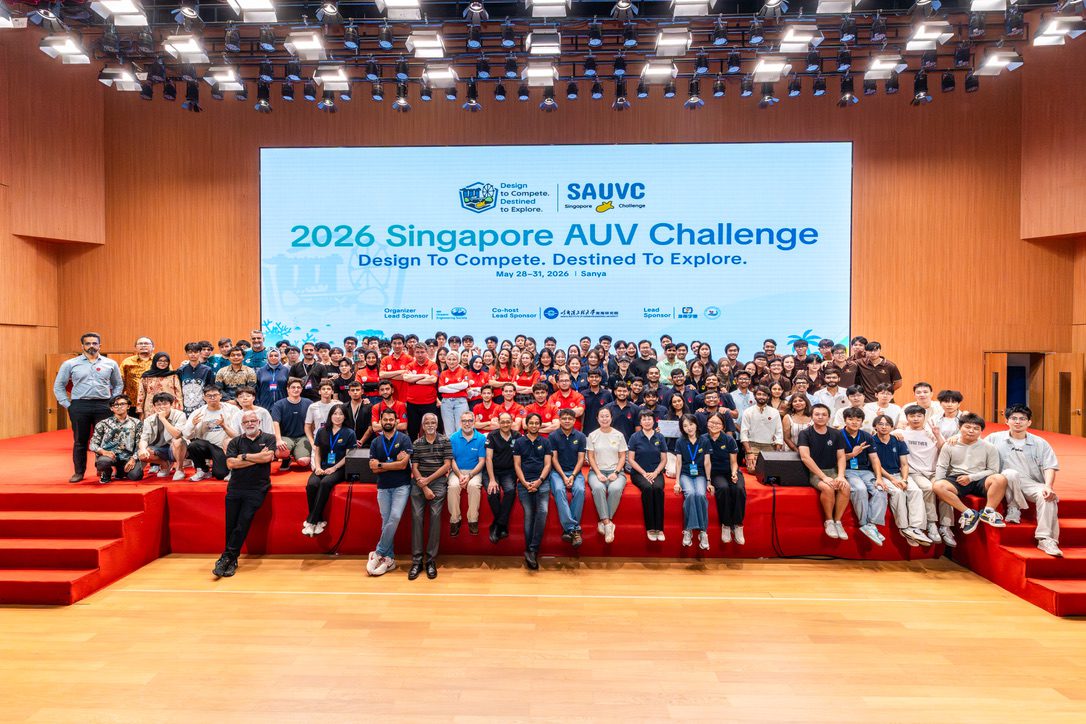
The SAUVC reached an important milestone in 2026, with the competition held outside Singapore for the first time since its inception.
2 Nov, 2026
Luyuan Peng (OES WIE Representative) and the SAUVC 2026 Organizing Committee
The Singapore Autonomous Underwater Vehicle Challenge (SAUVC) reached an important milestone in 2026, with the competition held outside Singapore for the first time since its inception. From 28–31 May 2026, teams gathered in Sanya, China, immediately following the IEEE OCEANS 2026 Sanya Conference, marking a significant step in SAUVC's continued international growth.
Hosted with the support of the Sanya Nanhai Innovation and Development Base of Harbin Engineering University, the event brought SAUVC to one of China's major centres for ocean science and marine technology. The move was more than a change of venue: it provided an opportunity to connect SAUVC participants directly with the wider ocean engineering community gathering for OCEANS Sanya.
SAUVC 2026 also introduced several new initiatives, including a stronger link between the IEEE OES Innovation Award and OCEANS, and the competition's first full-event livestream. Together, these developments made the 2026 edition one of the most internationally visible SAUVC events to date.
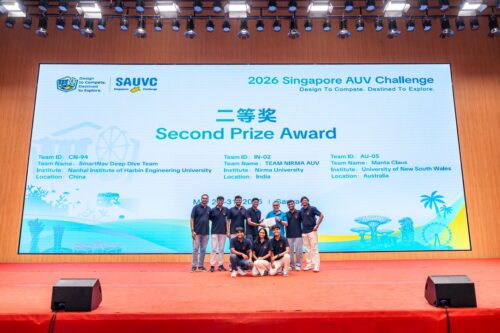
SAUVC 2026 participants and organizers at the closing ceremony in Sanya.

SAUVC 2026 in Numbers
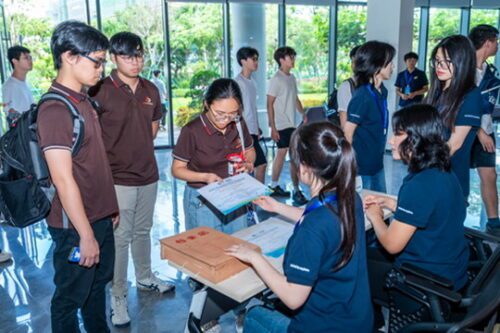
Teams register for SAUVC 2026 at the competition venue.
Interest in SAUVC continued to grow strongly in 2026:
- 120+ teams registered for SAUVC 2026 from around the world.
- Nearly 90 teams submitted pre-qualification videos, demonstrating functional untethered AUVs.
- 52 teams were shortlisted and invited to attend the competition in Sanya.
- 27 teams ultimately competed onsite, reflecting the continuing challenges teams face in securing travel funding, visas and transporting complex robotic systems internationally.
- SAUVC's accumulated geographic reach has now extended to teams from 22 countries and regions.
- The first SAUVC livestream attracted more than 4,000 online viewers, while total online and in-person viewership approached 5,000.
- Media coverage associated with the event generated more than 1.4 million views.
The increase from 83 registrations in 2025 to more than 120 in 2026 demonstrates the rapidly growing interest in hands-on underwater robotics education. The international move also introduced additional logistical challenges, particularly for teams travelling with large AUV systems and batteries, making the participation of 27 teams in Sanya especially encouraging.
A First for SAUVC: Moving Beyond Singapore
Since its establishment in 2013, SAUVC had always been held in Singapore. The decision to bring the 2026 edition to Sanya therefore represented an important experiment for the organizing committee and the wider SAUVC community.
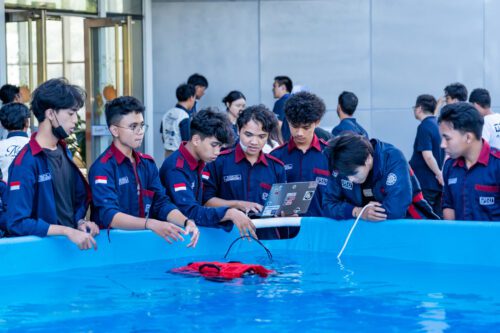
A team tests its autonomous underwater vehicle during the competition.
Organising SAUVC internationally required close coordination between the long-standing Singapore organizing committee and the local team in Sanya. The local support provided by Harbin Engineering University's Nanhai Institute was critical in arranging the competition venue, local logistics, volunteers and event support.
The successful execution of the event demonstrated that the SAUVC model can travel beyond Singapore while retaining the competition's strong focus on accessibility, education and student learning.
The Challenge
SAUVC challenges teams to develop fully autonomous underwater vehicles capable of completing missions inspired by problems faced by operational AUVs. The 2026 edition saw a significant redesign of the competition format. Unlike previous editions, the competition was conducted in a more compact 16 m × 25 m pool. Rather than simply scaling down the existing arena, the technical committee redesigned the finals to make better use of the available space while introducing additional challenges for the teams.
Teams first entered the qualification round, where their AUVs had to autonomously navigate through a gate without surfacing or making contact. Successful teams then progressed to a substantially revised finals format that tested a broader combination of autonomous capabilities within the more constrained arena.
The finals continued to assess the core capabilities central to SAUVC—navigation, perception, target acquisition and manipulation, target reacquisition, and underwater communication and localization—but through a denser sequence of tasks. With multiple objectives located within a smaller operating area, teams had to manage transitions between tasks, identify and reacquire targets, and execute autonomous behaviours reliably with less room for error.
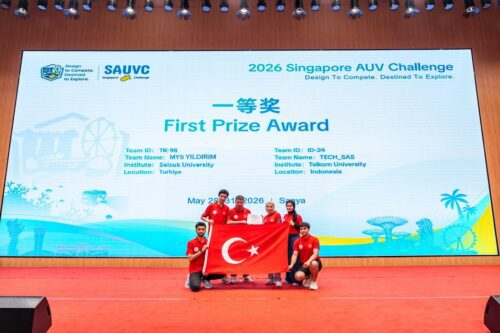
Joint champion MYS YILDIRIM from Selçuk University, Türkiye, receives the First Prize Award.
The communication and localization task remained one of the most technically demanding components of SAUVC. Three coloured flares were distributed around the competition arena. AUVs had to identify and approach the flares and bump them to release golf balls. Teams could obtain substantially more points by completing the flares in an order communicated to the AUV during the mission, requiring integration of underwater communication, localization, perception and autonomous decision-making.
The redesigned format placed greater emphasis on the integration and robustness of the complete robotic system. Teams had to bring together mechanical design, electronics, sensing, perception, control, autonomy and manipulation in an environment where failures in one component could quickly affect subsequent tasks. Despite the added complexity, teams demonstrated impressive resilience and creativity throughout the competition. The poolside environment was once again filled with rapid repairs, software debugging, last-minute mechanical changes and teams exchanging advice with one another between runs.
SAUVC 2026 Award Winners
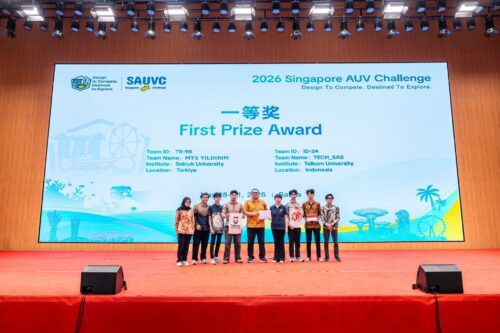
Joint champion TECH_SAS from Telkom University, Indonesia, receives the First Prize Award.
The Joint Champions were teams from:
- MYS YILDIRIM - Selçuk University, Türkiye
- Team Tech_SAS - Telkom University, Indonesia
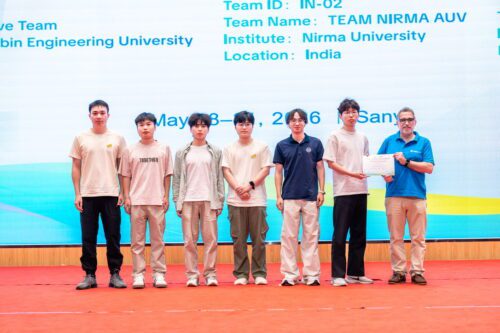
The three Second Prize teams were SmartNav Deep Dive Team from Harbin Engineering University, China; Team Nirma AUV from Nirma University, India; and MantaClaus from the University of New South Wales, Australia. Team Aquanox from Singapore Polytechnic received Third Prize.
The strong results from Türkiye and Indonesia continue a trend seen over recent SAUVC editions: teams from across Asia and beyond are becoming increasingly competitive as underwater robotics capabilities and experience spread across the student community.
Connecting SAUVC with OCEANS
SmartNav Deep Dive Team from Harbin Engineering University, China, receives Second Prize.
SAUVC took place immediately after OCEANS, creating an opportunity to connect student competitors directly with researchers, engineers and industry leaders from the wider ocean engineering community.
The connection was particularly strong through the IEEE OES Innovation Award.
For the first time, student teams were invited to submit a two-page technical extended abstract describing an innovation incorporated into their AUV. Teams were encouraged to explain the problem being addressed, the novelty of their solution, design choices and trade-offs, experimental validation and potential impact. Winning teams received sponsored registration to OCEANS Sanya and the opportunity to present their work in the conference poster session. This initiative was designed not only to reward innovative hardware or software, but also to encourage students to develop an important complementary skill: communicating engineering innovation through technical writing and presentation.
Team Nirma AUV from Nirma University, India, receives Second Prize.
- Dreadnought Robotics, Vellore Institute of Technology Chennai, India
- MYS YILDIRIM, Selçuk University, Türkiye
- T-Group, Northwestern Polytechnical University, China
Their participation at OCEANS helped bridge the student competition and professional research communities and offered participants an opportunity to receive feedback from experts beyond the competition itself.
This collaboration represents an important direction for SAUVC: combining hands-on engineering with opportunities for students to participate more deeply in the professional ocean engineering community.
A Global Audience: SAUVC's First Livestream
Another major first was the introduction of a full-event livestream.
For many years, one of SAUVC's challenges has been that only participants physically present at the pool could experience the competition as it happened. This changed in 2026.
The livestream allowed families, universities, former competitors and marine robotics enthusiasts from around the world to follow the competition remotely. More than 4,000 viewers joined online, making SAUVC 2026 the most-watched edition of the competition to date.
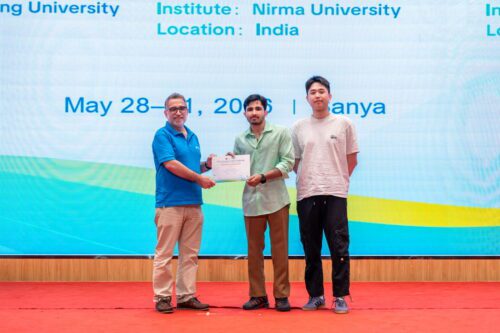
MantaClaus from the University of New South Wales, Australia, receives Second Prize.
This expanded digital reach represents an important new avenue for SAUVC. Underwater robotics competitions can be difficult to watch because much of the action occurs below the water surface; developing better livestreaming, underwater visualization and commentary therefore has significant potential to make future competitions more engaging and accessible to a global audience.
Award Ceremony and Gala Dinner
SAUVC 2026 concluded on 31 May with an award ceremony at the Innovation Research Valley Auditorium, followed by the traditional SAUVC gala dinner.
After several intense days of transportation, vehicle assembly, practice, qualification and finals, the closing event provided teams with an opportunity to relax and celebrate together.
Beyond recognizing the winning teams, the ceremony also acknowledged the many groups that made this first overseas SAUVC possible: the local organizing committee, sponsors, judges, divers, volunteers, mentors and members of the Singapore organizing committee.
A recognition plaque was also presented to the local organizing committee in appreciation of its contribution to bringing SAUVC to Sanya.
The gala dinner continued one of SAUVC's most valuable traditions. While teams arrive as competitors, the event also provides a rare opportunity for hundreds of students interested in marine robotics to meet one another, exchange designs and experiences, and establish connections that often continue long after the competition has ended.
Sponsorship and Local Support
SAUVC remains distinctive among international student robotics competitions because no registration fee is charged to participating teams.
Maintaining this policy is particularly important for teams from developing countries, where the costs associated with developing an AUV and travelling internationally can already be substantial. It also means that the continued support of sponsors, partner institutions and volunteers is fundamental to the sustainability of the competition.
SAUVC 2026 was organized by the IEEE Oceanic Engineering Society Singapore Chapter, hosted by the Sanya Nanhai Innovation and Development Base of Harbin Engineering University, with support from the National University of Singapore, and Singapore Polytechnic and.
The organizing committee would also like to acknowledge the sponsors and local partners whose financial, technical and logistical support made the Sanya edition possible.
Concluding Remarks
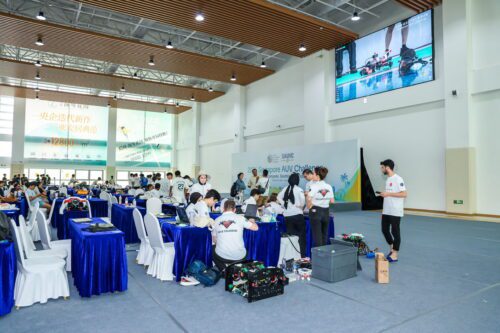
Teams prepare their AUVs while poolside action is shown on the competition livestream.
Moving the competition outside Singapore for the first time was an ambitious undertaking. It required a new venue, a new local organizing structure and substantially more coordination across countries. At the same time, more than 120 registrations demonstrated that the global student underwater robotics community continues to grow.
More importantly, the event expanded what SAUVC can offer.
The collaboration with OCEANS introduced students to technical writing and professional conference participation. The Innovation Award gave engineering creativity greater visibility. The livestream opened the competition to thousands of people who could not attend physically. And hosting the event in China brought SAUVC to a new regional community while preserving the accessible and educational philosophy on which the competition was founded.
Over more than a decade, SAUVC has grown from a competition involving teams from four countries into a community that has attracted participants from 22 countries and regions. Former participants have gone on to marine robotics research groups, industry positions, international competitions and underwater robotics startups.
The 2026 edition demonstrated that the impact of SAUVC extends beyond who scores the most points in the pool. The competition gives students a reason to build real underwater robots, learn why real systems fail, solve problems under pressure, share ideas with peers from around the world and become part of the ocean engineering community.
After its first international edition in Sanya, SAUVC will return to Singapore from 24–26 February 2027, bringing the experience gained in Sanya back to where the competition began.
SAUVC continues to design to compete—and be destined to explore.